
The Sustainability
of Experiential Design
by Kristen Harding | Senior Experiential Designer
& Jessica Roach | Intermediate Experiential Designer
Every material design choice has a footprint—affecting the global ecosystem, human health, and the built environment. As experiential design professionals, we know that the materials used in a branded graphic or immersive space could negatively impact the environment through their sourcing, production, chemical emissions, and end-of-life waste. It is our responsibility to make sure they don’t. As the demand for experiential graphics increases alongside an expectation of responsible design, sustainability at IA— aligned with our commitment to the SBTi, ESG, AIA 2030, and our recent CDP disclosure—is as fundamental to the design process as functionality, well-being, and aesthetics.
Decision-makers who want to incorporate experiential graphics into built spaces, maintaining design quality and performance while reducing their environmental footprint, can be certain their goals are achievable through planning, strategy, design expertise, and the many eco-friendly materials now available. But where to start, and what are some of the new sustainable materials to choose from?
Evaluating Materials
The process begins with a life-cycle assessment (LCA), a comprehensive method for evaluating the environmental footprint of all the materials proposed for a design project across five key stages:
- Raw material extraction
- Production and manufacturing
- Distribution and transportation
- Usage phase
- End-of-life disposal
This framework provides data that helps us identify and evaluate the materials’ ecological impacts and select the best options for the environment, the design, and the client’s objectives.
Material Options
Today, there are more low-impact sustainable products to choose from than ever before. In response to the push for environmental responsibility, the development of eco-friendly design materials is rapidly expanding, with the global sustainable materials market anticipated to increase from about USD 421.17 billion in 2026 to USD 1,183.54 billion by 2035. Products, like low-VOC paint and LED lighting, are well known for their minimal environmental impact. But what are some of the newer sustainable materials, particularly those focused on signage, a significant aspect of experiential graphic design?
Today, there are durable, sustainable signage options ideal for a variety of applications, from workspaces to retail displays to event signage. For example, signage systems made of recyclable aluminum can repeatedly be refreshed by simply changing the graphics in the frames. And the graphics are eco-friendly, made from post-consumer waste, and contain no microplastics. Plus, their production requires 90% less water than other textiles. Printed with water-based inks, they ensure a lower ecological footprint than traditional signage.
Acrylic signs, a traditional choice, have been popular for business and organizational use across countless applications. Known for its clarity, strength, and lightweight, acrylic is impact-resistant, shatterproof, and easily fabricated or cut into custom shapes and sizes. However, it is a transparent plastic made from petroleum through an energy-intensive process requiring high temperatures and pressure. To produce 1 kg of acrylic, approximately 6 kg of CO2 are released into the atmosphere. Discharging greenhouse gases and toxic chemicals that can take up to 200 years to decompose, they are almost impossible to recycle. Acrylic is a poor choice for the environment.
But Recrylic®, a new product released in 2022, is made from used and scrap acrylic through an innovative proprietary process. It is UV-resistant and available in a range of colors, finishes, and thicknesses. Used exactly the same way as acrylic, Recrylic® is completely recyclable—its lifecycle a closed-loop that can repeat indefinitely. Made from chemically inert recycled plastics with no detectable levels of VOCs (verified through independent testing), it performs like traditional acrylic but reduces carbon emissions by 90% and avoids landfill use. Plus, the recovery process produces a distillate that fuels approximately 35% of the operation, making the process itself more environmentally friendly.
One purveyor of custom ADA signs (required in all public accommodations and commercial facilities) bonds Recrylic® with photopolymer, combining the best features of both products. The result is a 95% recyclable material that reduces waste, lowers carbon emissions, and provides cost-effective solutions compared to petroleum-based alternatives.
What about vinyl? Although a very common material used in signage and graphic applications, vinyl is an adhesive-backed film made from polyvinyl chloride (PVC). It is not considered biodegradable and its reuse is limited. PVC and other plastics can only be recycled a finite number of times. Each time plastic is melted and processed, its polymer chain is shortened, reducing its quality. Furthermore, recycling plants must add virgin material—new plastic—into the mix to make recycled plastic usable.
Once a graphic is printed and cut from a vinyl sheet, the remaining vinyl and transfer tape used to lift it from its backing to another surface are often discarded. Overall, vinyl graphic-making processes produce more waste than product (sometimes 50% to 90% waste).
Although it may not be realistic to eliminate all vinyl specifications, alternatives should always be explored along with new sustainable options as they become available. Current alternatives include printing directly onto surfaces, painting, using wood for signage, and creative options like those discussed for ADA signage, as well as sustainable systems.
The Goal and Pushing Boundaries
The ultimate goal of experiential graphics is the design of memorable, relevant, immersive environments that heighten the human experience, while doing as little harm to the environment as possible. Still, while mindful of materials’ environmental impacts, experiential design practitioners push design boundaries in response to client demands for original, meaningful, sustainable installations and design moments. Two recent projects from our portfolio prove the point.
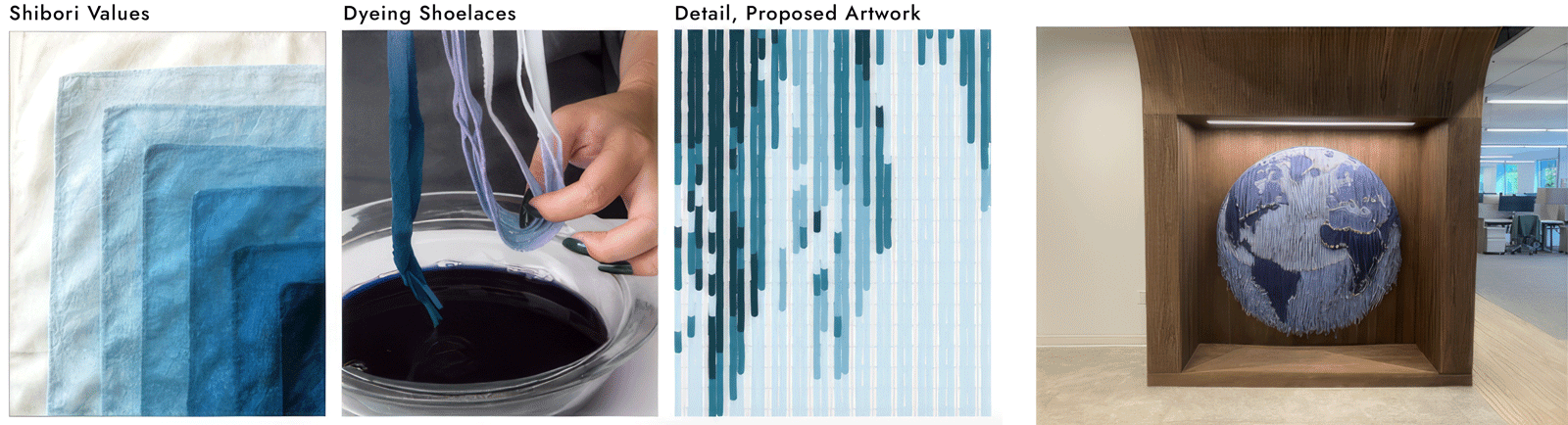
During a major renovation of its four-building campus, Deckers Brands, a global designer and distributor of footwear and apparel, transformed a former storage facility into a dynamic showroom for its multiple lines of business. This transition required the relocation or sustainable disposal of large volumes of stored materials.
Among the surplus goods were thousands of white shoelaces—an unlikely resource to become a central design feature, but the experiential design team reimagined their potential. Inspired by the 1,300-year-old Japanese shibori dyeing technique, they hand-dyed the shoelaces in varying concentrations of indigo to produce a range of blue tones and then carefully arranged them across a grid framework.
The resulting installation of shoelaces creates a dimensional representation of the globe, emphasizing Deckers’ international reach. Suspended in the workplace, the piece gently shifts with the airflow, introducing movement and a sense of lightness that reflects the breezy character of the headquarters’ Santa Barbara setting. The use of blue—central to the Deckers brand identity—reinforces themes of calm and cohesion throughout the workplace. The striking installation supports sustainability and storytelling, enhances the employee experience, and reflects the client’s identity and mission.
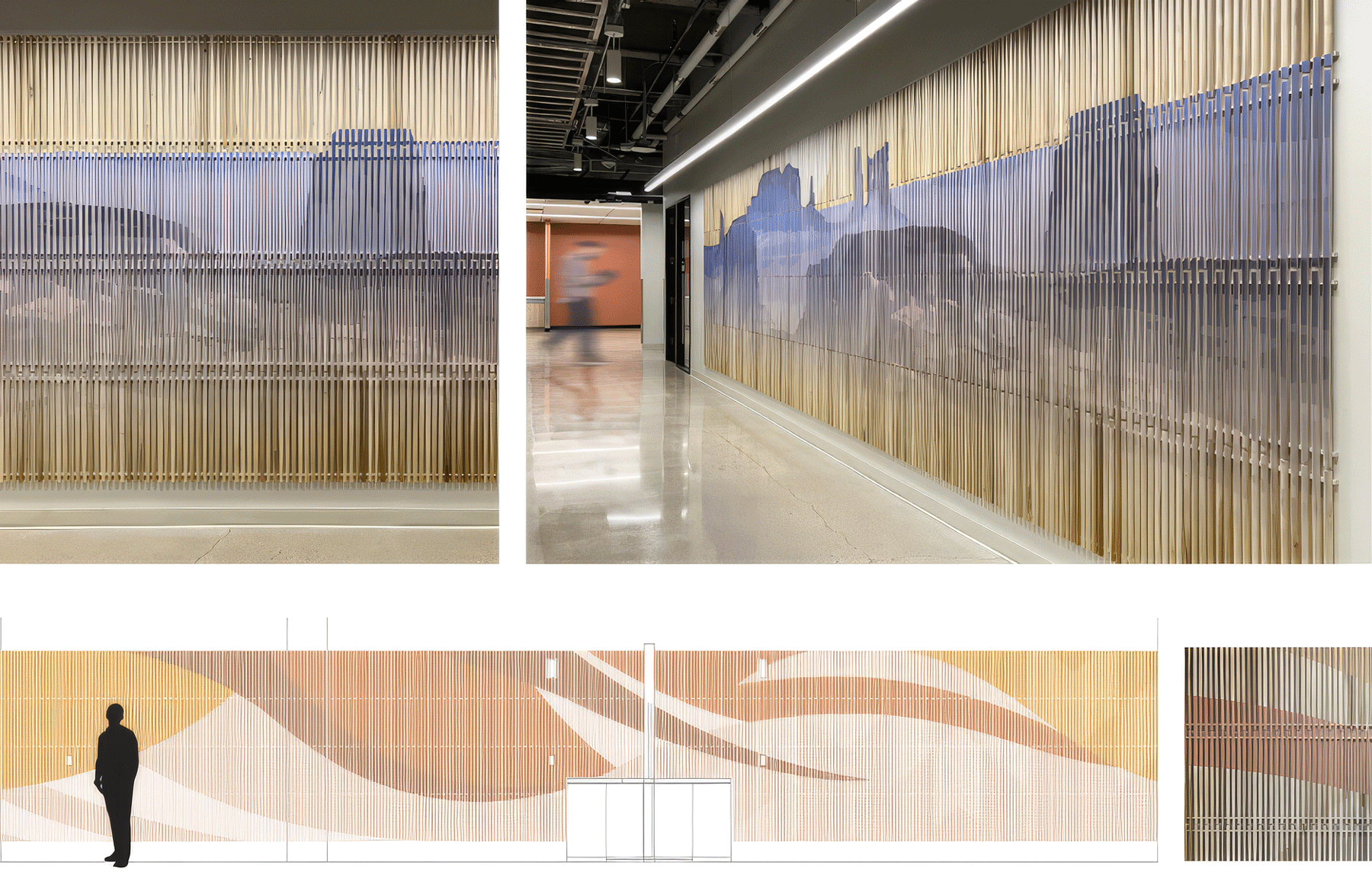
For another project, a global E-Commerce Fortune 50 client engaged the IA team to reimagine the employee experience at its call center— an environment that operates 24/7 and often demands long, unconventional working hours. The goal was a workplace that promotes calm, comfort, and well-being, drawing on biophilic design principles and inspiration from the surrounding desert landscape.
A floor-to-ceiling installation of wooden dowel rods is the defining feature. The choice of wood, biodegradable and fully recyclable, sets the biophilic narrative, bringing a natural, tactile dimension to the space. The material, texture, and imagery create a tranquil rhythm and connect to nature, counterbalancing the intensity of a round-the-clock call center setting with moments of visual and emotional relief.
The project has been recognized for excellence in environmental graphic design, with industry representatives deeming it a standout example of the discipline at its best.
Conclusion
Experiential graphic design should always strive to be environmentally responsible. Working with clients, design professionals can identify responsible choices based on research and an LCA to strategize and ensure the success of project objectives. The use of sustainable materials throughout the life of a project and beyond creates positive outcomes for the human experience, ecological well-being, and the circular economy.

Kristen Harding
Senior Experiential Designer

Jessica Roach
Intermediate Experiential Designer