
The Harmonic Principles™:
Experiential Harmony
By Valerie Jardon | Strategy Director
& Dr. Sally Augustin, PHD | Director of Research
This is the second in a series of three posts that explore in greater depth our introduction to the nine Harmonic Principles™, IA’s seminal framework for aligning strategy, design, and science in concurrent harmony for any environment. The principles are bundled in groups of three under each of the Harmonic Dimensions: Spatial, Experiential, and Relational.
Your Harmony Revealed
Explore which Harmonics could be most impactful for your organization.
We have created a short quiz to explore which of the Harmonics could be the most impactful for your organization, elevating the environment and culture. Please click the link below, take the quiz, and receive your personalized Harmony Revealed one-pager, which will include insights unique to your responses.
The Dimension of Experiential Harmony
The second dimension of Harmony, explored in this post, unveils the elements that supercharge positive moods and experiences in sensory-rich spaces to provide satisfaction, vibrancy, and reflection. Through deliberately crafted environments, Experiential Harmony creates magnetic spaces that enhance organizational and individual performance by creating compelling environments where people can achieve their fullest potential professionally and socially.
Within this dimension are the principles of Salient Features, Sensory Richness, and Sustainable Revitalization focused on experiential factors that create truly harmonic, healthy, and dynamic environments. Their application to design is pragmatically measurable—each principle paired with a trackable set of outcomes that builds a compelling scenario around benefits and the costs of investment.
As noted in previous posts, the principles are underlined by years of research and development in neuroscience, anthropology, sociology, psychology, and more specifically on research conducted largely in the last decade that identifies the sensory, cognitive, emotional, and motivational processes that generate responses to design.
Salient Features
The principle of Salient Features refers to carefully selected elements that communicate through nonverbal messaging and enhance constructive in-space experiences. This is design for satisfaction, laying the foundation for solo and team performance at full potential. User satisfaction and identification with place increase when environments communicate that people are seen, supported, and respected, and when design aligns with the activities and identities of those using the space.
Rather than relying on singular focal points or visual hierarchy alone, Salient Features operate as a system of cues that reinforce meaning, value, and purpose. These cues shape how users interpret a space—what is important, who it is for, and how they are valued—making environments more memorable and relevant to their users.
A feature is not limited to a single object or moment. It can be a highly specialized amenity, an upgraded material decision, a service touchpoint that goes above and beyond, or a spatial condition that signals care and intention. These elements can range from bold, expressive moments to subtle, distributed signals embedded throughout the environment. The most effective solutions are those that consistently communicate value in ways that align with user expectations, identity, and culture.
Memorable components may also be temporary. While permanent installations can reinforce long-term identity, short-term or evolving interventions can communicate timeliness, responsiveness, and organizational relevance—supporting current initiatives, milestones, or events.
Opportunities to create meaningful experiences through salient features are varied. Moments of discovery, shared interaction, or cultural resonance can strengthen satisfaction and identification with place. Features that invite engagement—whether social, tactile, or symbolic—can deepen connection and reinforce positive perception. In retail and hospitality environments, these experiences can translate into increased loyalty and engagement.
Intentional design decisions—particularly those that signal care, investment, and alignment with user values—shape how people interpret and respond to a space. These nonverbal messages influence satisfaction, pride, and overall perception, especially for first-time users or individuals returning to shared environments. Increased satisfaction and identification with place remain the primary measures of Salient Features.
An example of Salient Features from our portfolio is a three-floor conference center that accommodates traveling and local team members of a confidential client. The objective was a highly engaging, colorful, and experiential space that would be memorable and almost transportive, especially for those spending a long day there.
The design creates moments of surprise through the play of light, geometry, and color, using these elements not just for visual impact but to communicate energy, creativity, and a clear investment in the user experience. An orange-red stair connects the three floors, acting as a deliberate and visible signal of connection and importance within the space, while each level expresses a distinct character.
Throughout, environmental graphics and material applications reinforce this narrative. Color, geometry, and light are used to convey identity and intent, shaping how the space is interpreted and valued. At the top of the stairs, the construction and placement of walls create a three-dimensional zigzag condition that, through changing light and material sheen, reads as dynamic and evolving over the course of the day—an ongoing expression of movement and energy embedded in the environment.
Together, these elements operate as a coordinated set of cues that communicate what the space represents and how it values the people using it. This reinforces a more meaningful and memorable experience, increasing satisfaction and strengthening identification with the place.
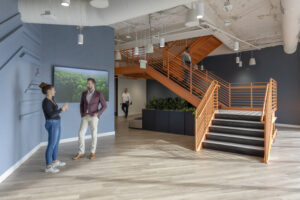
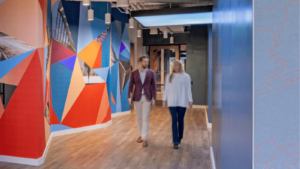
Confidential Client, Denver, CO | Photography by Frank Ooms
In another project for a confidential client, the design draws on the character of Chicago to communicate a strong sense of regional identity. Ceiling treatments and lighting reference the nearby Chicago River, while floor graphics, zoning, and color blocking are inspired by Chicago neighborhoods. These layered cues use familiar visual language to express location and cultural context within the space.Rather than relying on overt branding, the design embeds these references throughout the environment, allowing the space to signal local pride and organizational connection to place in a subtle but consistent way. This approach creates a meaningful and recognizable identity without compromising the overall brand, reinforcing satisfaction and strengthening users’ identification with the space.
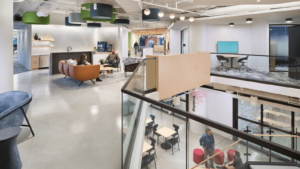
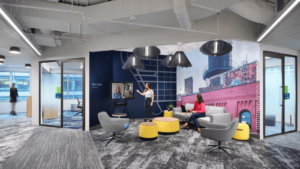
Confidential Client, Chicago, IL | Photography by Patsy McEnroe
Together, these elements operate as a coordinated set of cues that communicate what the space represents and how it values the people using it. This reinforces positive perception, increasing satisfaction and strengthening identification with the place.
Sensory Richness
The principle of Sensory Richness refers to varied, multi-sensory experiences that elevate users’ moods. This is design for vibrancy, taking mood to a higher level.
Science confirms that a good mood encourages optimal workplace performance—as well as sales in retail environments and satisfaction in hospitality environments. Layered multi-sensory experiences that engage users have the ability to create positive emotions that support cognitive performance, social connections/cohesiveness, and creativity. Stimulation of the senses that connect people based on shared affinities and preferences contribute to the meaning and impact of their experience, creating memories and inspiring engagement with the mission and community of the organization and its built environment.
Sensory Richness need not be in your face. Creating the right amount of sensory excitement in scale and quality to achieve a targeted attention level without overwhelming users depends on intent and objectives. High stimulation, for example, might be appropriate for some retail spaces but overwhelming for others. Providing a variety of sensory approaches is critical for success in workplaces and hospitality environments alike.
Typically, users in any environment will choose one sensory experience over another based on their activity and objectives. Choice is essential. With choice, the reward sections of the brain light up, creating another positive benefit.
Sensory Richness also addresses sensory-related complaints about visual, acoustic, and thermal distractors. There are many ways to ensure sensory comfort, including adjustable thermal controls, carefully designed acoustics, lighting options, and zoning that let users identify the most comfortable and best-suited areas for their preferences and tasks.
Demographics is another key factor; age is a good example. Older people generally require more illumination and larger print for signage. This is particularly relevant for retail and hospitality environments because users may retire from the workplace but will continue to shop and are likely to travel during their lifespan.
An immersive digital experience is an additional option gaining popularity in workplace, retail, wellness, and museum environments. During these events, participants engage more fully with the subject of the immersion for a heightened personal and internalized experience. Displays and vignettes can also be meaningful.
From our portfolio, drawing on Sensory Richness, data cloud company Snowflake capitalizes on its name with a sense of fun. Complementing a custom iceberg-style desk, the sounds of winter are piped into the lobby. Moreover, on a wall in the lounge, many of the world’s highest mountains, known for their snow-capped peaks, are graphically depicted.
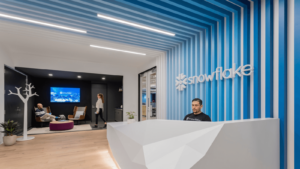
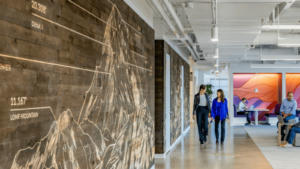
Snowflake, Dublin, CA | Photography by Emily Hagopian/Hancock
At DraftKings headquarters in Boston, a focus on sports to define space engages the senses with color and architectural elements that experientially connect with the organization’s mission to deliver fantasy sports, iGaming, and more.
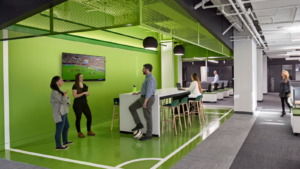
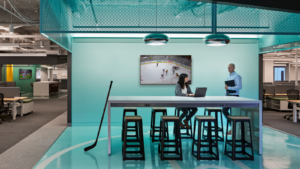
DraftKings Headquarters, Boston, MA | Photography by Robert Benson
An emotionally satisfying environment that positively supports teamwork by stimulating the senses and inspiring engagement, as well as a reduction in sensory-related complaints, are measures of Sensory Richness.
Sustainable Revitalization
Sustainable Revitalization refers to spaces and practices that nourish users as they mentally refresh, via, for example, an absorbing ambiance where users feel transported. This is design for reflection.
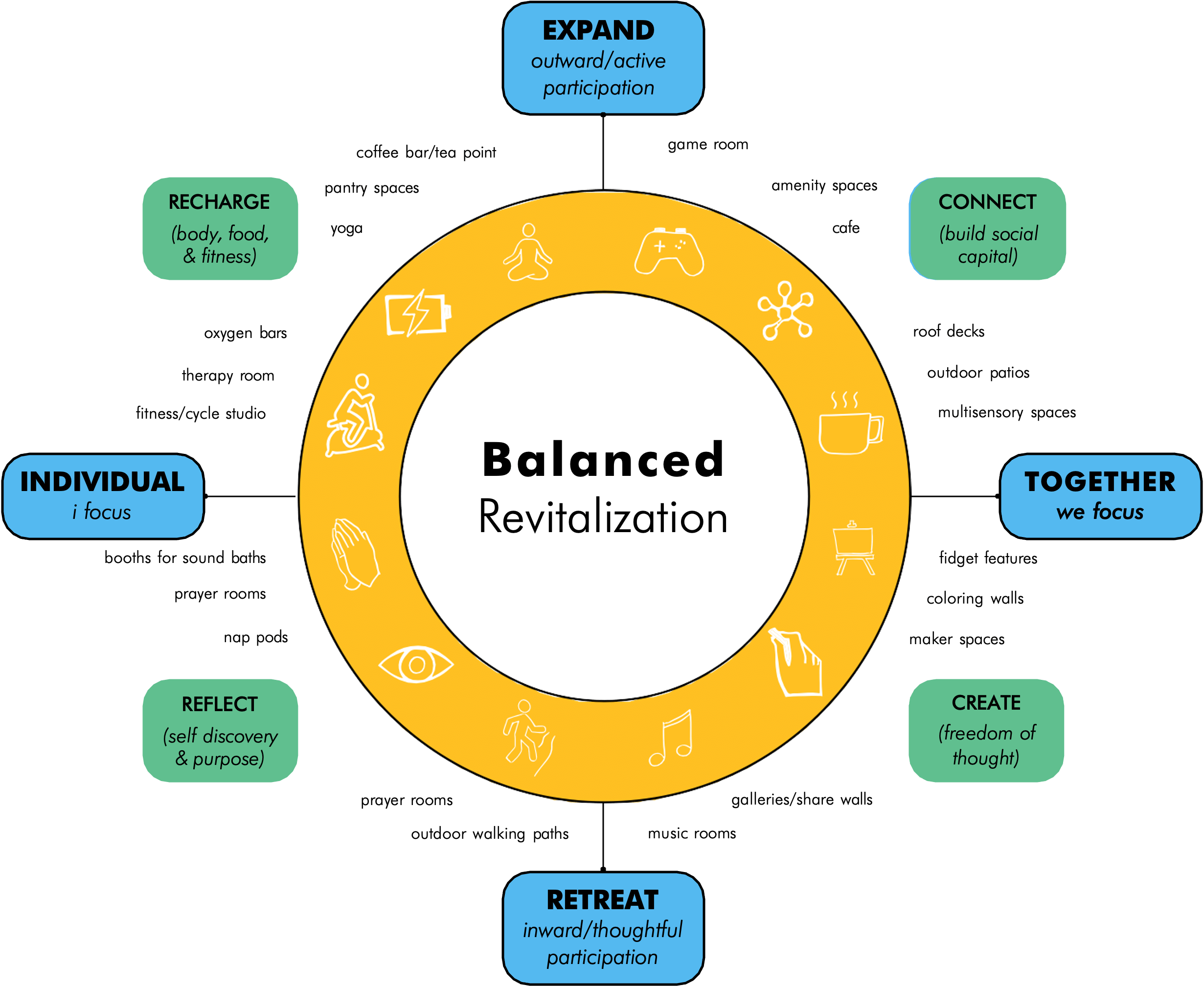
Augustin & Oseland (Eds.), (2024,) Science of People and Office Design, Routledge, Chapter 13.
Toward that goal, research continues to confirm the positive effects of natural environments on cognition and the reduction of mental fatigue. Biophilic design therefore acts as a foundational design constant—supporting all Harmonic Principles™—and can be intentionally leveraged here to help combat burnout.
Organic forms, natural materials, daylight, and access to greenery can contribute to restorative conditions, while principles such as prospect and refuge can support moments of pause. The growing interest in Blue Spaces further reinforces the value of these strategies, with gently moving water—whether physical or simulated—contributing to calming conditions that encourage mental decompression. However, these nature-based approaches represent just one pathway to revitalization.
Sustainable Revitalization also depends on creating opportunities for cognitive reset that are not reliant on biophilic inputs. Environments that reduce cognitive demand—those that are absorbing but not demanding—allow the brain to shift out of focused, task-oriented thinking into lower-effort, reflective states. Equally important is the presence of spatial and cultural cues that signal permission to pause. Without this, even well-designed environments may fail to support true restoration.
Contrast plays a critical role. Moving between conditions that differ from primary work settings—whether through changes in scale, enclosure, light, or atmosphere—can prompt a psychological shift that supports mental recovery. These transitions do not need to be dramatic; even brief departures from task-based environments can provide meaningful opportunities to reset.
Movement itself can also be restorative. Traveling through a space—vertically or horizontally—introduces a shift in perspective that can interrupt cognitive patterns and refresh thinking. Similarly, changes in posture or orientation, such as sitting closer to the ground or in alternative configurations, can support a mental reset by engaging the body in different ways.
Experiences that allow users to mentally step away—whether through immersion, reflection, or brief disengagement—are central to this principle. These moments do not need to be continuous or highly programmed; intermittent opportunities to reset are often sufficient to reduce fatigue over time.
Across these approaches, the goal is not simply to create calming environments, but to intentionally enable moments where users can disengage from cognitive demands, reflect, and return with greater clarity. These opportunities—whether spatial, behavioral, or cultural—are essential for reducing burnout and sustaining long-term performance.
Opportunities for revitalization can take many different forms, some unique to the organization. For one confidential client (and other organizations as well), the timeless tradition of the Council Circle, dating back to indigenous traditions, is a transporting experience integral to the; organization's culture. Sitting in a circle on the floor, participants take turns sharing their thoughts and experiences on a chosen subject, respectful, of one another, and listening deeply without judgment, building community and connection through authentic communication. Council room designs from our portfolio use natural and soft materials with layers of lighting.
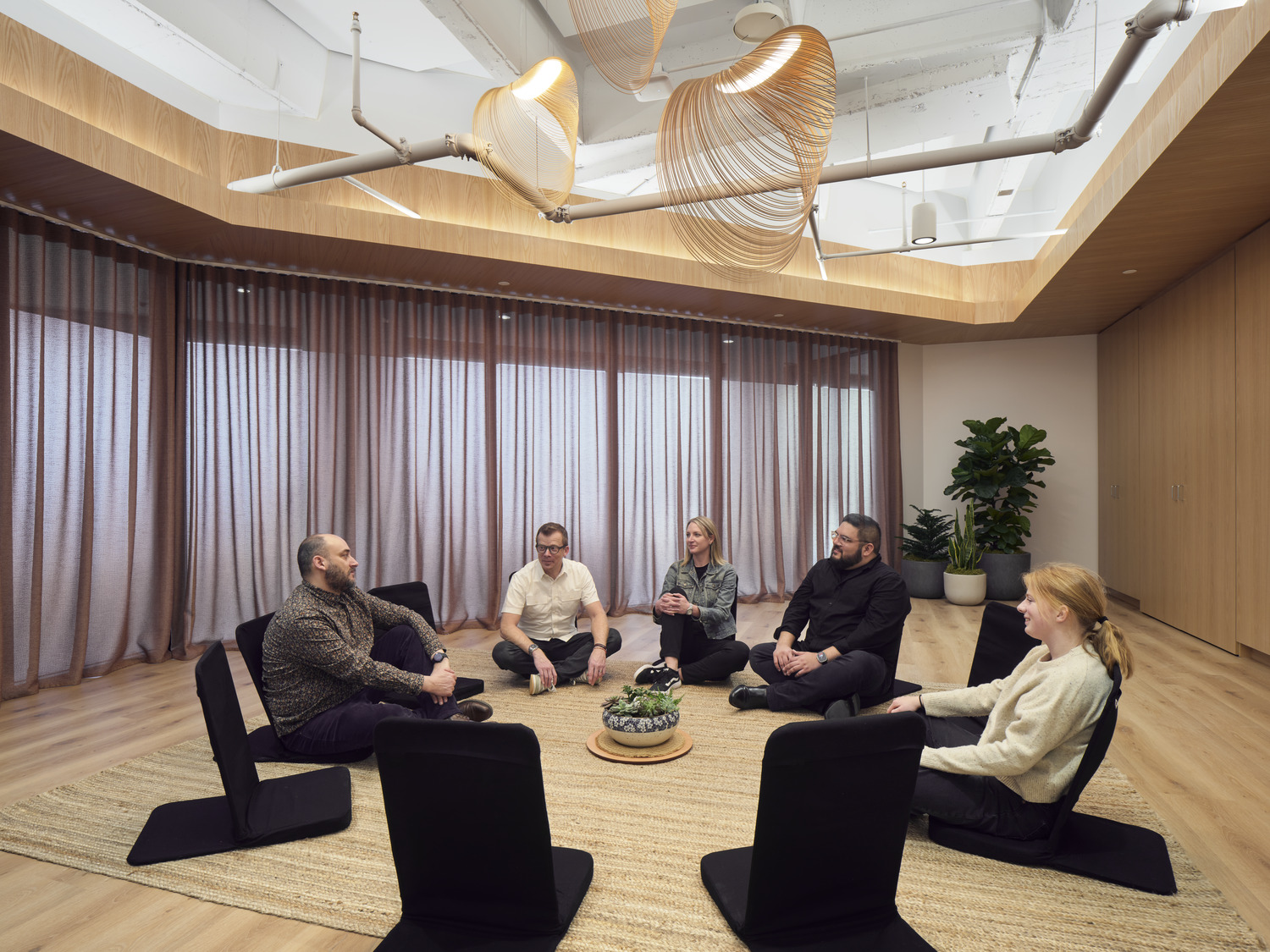
Confidential Client | Photography by Andrea Calo
Other clients support voluntary programs where employees can talk through key public sector concerns in the public sector or participate in art programs. Some provide sophisticated gyms for employee use or outdoor environments with walking paths. The point is to create restorative options for the individual or in social settings depending on user preference.
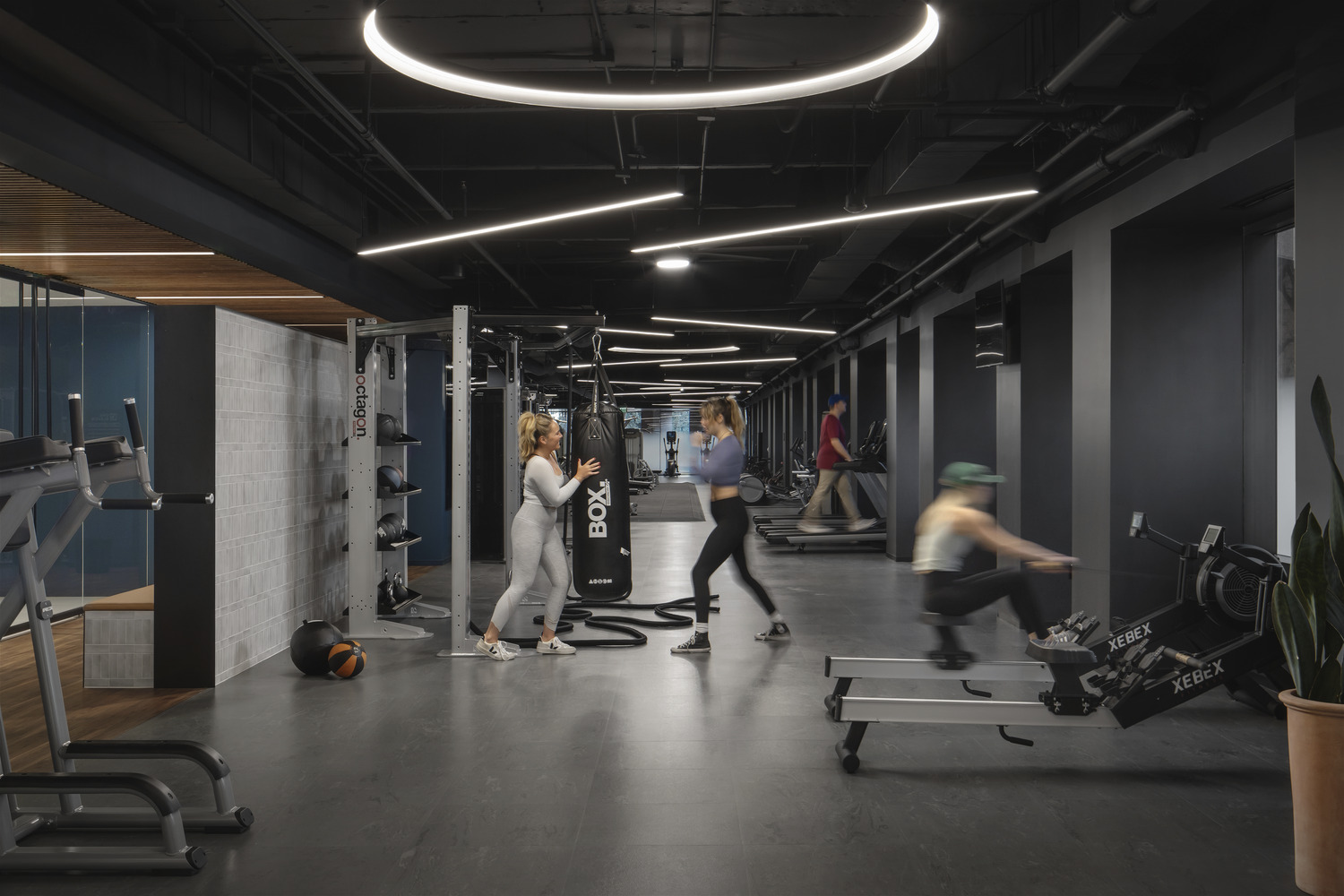
Confidetial Client | Photography by Andrea Calo
Applying the principle of Sustainable Revitalization positively influences the mental states associated with burnout, mental exhaustion, and absenteeism, heightening social connections, satisfaction levels, talent recruitment, and retail sales. The measurable outcomes of Sustainable Revitalization can be gauged by assessing positive change in these areas.
Conclusion
The Experiential Dimension, prefigured by the Spatial Dimension, organically segways to the Relational Dimension, our next post in this series as we move beyond human-centered design. Curious? Stay tuned.

Valerie Jardon
Managing Director, Strategy
With a passion for understanding people to create purposeful spaces, Valerie is a respected leader within the design industry where she pushes workplace innovation for global corporate clients in her role as the Director of Strategy at IA Interior Architects. With 18 years of experience, her holistic research extracts emerging needs and propels companies into the future of belonging through an empathetic yet results-driven lens—fusing her design degree and business savvy from an Executive MBA to unlock the potential of places and people in the workscape.

Dr. Sally Augustin, pHD
Director of Research
Sally Augustin, PhD, is a practicing environmental psychologist and the Director of Research at IA. She has extensive experience integrating neuroscience-based insights to develop recommendations for the design of places, objects, and services that support desired cognitive, emotional, and physical outcomes/experiences. Augustin, who is a Fellow of the American Psychological Association, is the co-editor of The Science of People and Office Design (2025) and a 2024 TEDx speaker.
With contributions by Holly Jeffers, Shane Smith, Philip Metzger, Andrea Benatar, Jessica Stoffers, Clark Pickett, Emma Morris, Carlotta Dove, Alyssa Alvarez, Gary Bouthillette, Diana Ruiz, Darwen Hinton, John Hopkins, Helena Keeling, Bhumi Patel